How AI Put the "—" (Em Dash) on Trial
Have you noticed this symbol appearing everywhere recently: —?
It is longer than a hyphen and longer than an en-dash. Its name is the em-dash. A few years ago, most people would have simply read a sentence containing one without thinking about the punctuation. Today, an em-dash in a LinkedIn post, an email, or even a university assignment can immediately create suspicion: “Was this written by AI?”
I have seen people point at the symbol say it is a watermark secretly left by ChatGPT. Some writers have even started asking AI tools to remove all em-dashes from generated text (forgive me, I’m also one of them), while human writers who used them for years now avoid them so that their own writing will not look artificial.
The strange thing is that the em-dash is not an invention of the AI era. It is an old and useful punctuation mark. It was used in printed books long before computers, social media, or large language models existed. However, within a very short time, its public identity has changed. A symbol that once represented a pause in a sentence is now treated as evidence of a machine behind the sentence.
So, how did an innocent punctuation mark become a victim of the AI era?
The Long Life of the Em-Dash
First, it is worth understanding what the name means. In typography, an em is a unit related to the size of the type, which is equal to the width of the character “M”. The Unicode Standard describes the em-dash (U+2014) as a character used to create a break in the flow of a sentence [1].
It can replace commas, parentheses, or sometimes a colon when a writer wants a stronger pause.
The em-dash creates a small interruption. The second part of the sentence feels more dramatic than it would with a comma. That flexibility is what makes the symbol attractive to writers. It can insert an explanation, mark a change of thought, or give emphasis without ending the sentence.
Here are some examples of how it can be used:
1. Add emphasis or an interruption
An em dash creates a stronger pause than a comma.
The solution was simple — restart the service.
2. Insert additional information
It can replace parentheses when you want the inserted information to feel more prominent.
The API — which was originally built in 2021 — needs a major refactor.
Compare:
The API (which was originally built in 2021) needs a major refactor.
3. Replace commas around a parenthetical phrase
This is especially useful when the sentence already contains several commas.
Three technologies — Django, PostgreSQL, and Redis — are involved in the backend.
This is often clearer than:
Three technologies, Django, PostgreSQL, and Redis, are involved in the backend.
So, now you see that this is not an AI related thing, or recent invention. An American Dictionary of Printing and Bookmaking, published in 1894, defined the em-dash as a dash — one em long and described it as being used for a pause [2]. That reference alone places both the name and the purpose of the mark well over a century before ChatGPT or any LLM.
Writers were using long dashes even earlier. They can be found throughout old novels, essays, letters, and newspapers. Their exact appearance depended on the printer, the typeface, and the publishing style. Sometimes the dash had spaces around it; sometimes it touched the surrounding words. Sometimes a printer used more than one dash to represent missing words or an interrupted name. The rules were never as universal as people now imagine.
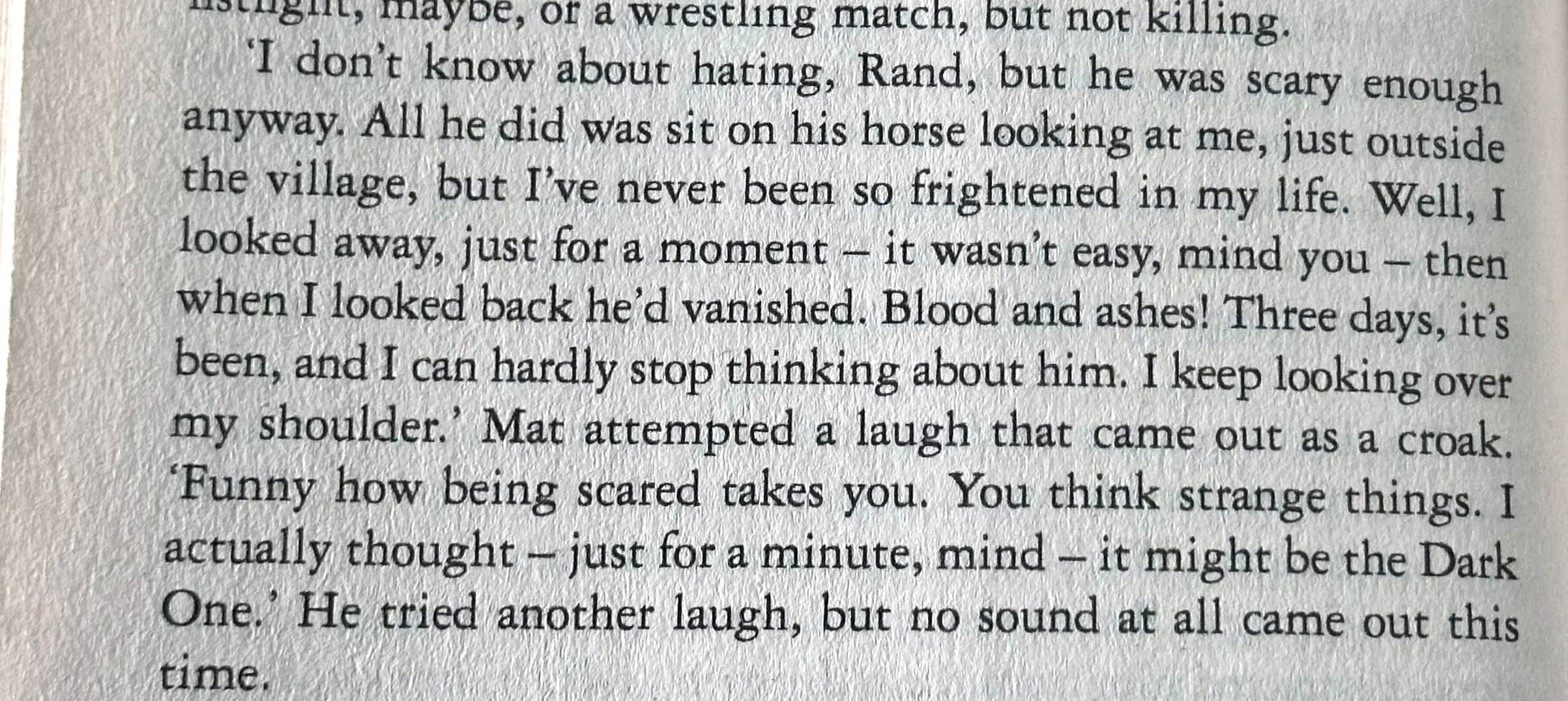
This is a page from one of my favorite books, “Wheel of Time - Eye of the World” by Robert Jordan, published in 1990. The em-dash appears several times on this paragraph, to inter-connect a few sentences with a pause. The book was printed long before the AI era, yet the symbol is already present.
An ordinary printed novel from the 1990s is also enough to challenge the claim that the em-dash came from AI. Then why do many of us feel that it was uncommon before?
One practical reason is the keyboard. A hyphen has its own key. An em-dash usually does not. On a typewriter or a basic computer keyboard, writers could easily type a hyphen, or two hyphens together, but producing a proper em-dash required a special key combination, a character menu, or automatic replacement by a word processor. It belonged naturally to the typeset world of books and magazines, but less naturally to quick emails, text messages, and early online conversations.
The symbol was never absent. It was simply less visible in the everyday digital writing most people produced themselves. So why does it suddenly feels more common now?
The Sudden Change in Visibility
Generative AI changed that visibility. Millions of people now ask language models to draft emails, social-media posts, reports, descriptions, and articles. The generated text often arrives already polished, with headings, bullet points, balanced sentences, and typographically correct punctuation. The user does not need to know the keyboard shortcut for an em-dash. The model returns the symbol directly.
Once enough AI-assisted writing entered public spaces, readers started noticing repeated patterns. The em-dash was easy to spot because it is visually distinctive. Unlike a common word such as important or however, the symbol stands out from a paragraph. It became a simple story that could spread through social media: em-dash means AI.
But simple stories are often incomplete. Have you ever thought why AIs using em-dash more often than humans? You need to know a little about how a large language model writes to understand the answer.
How a Large Language Model Writes
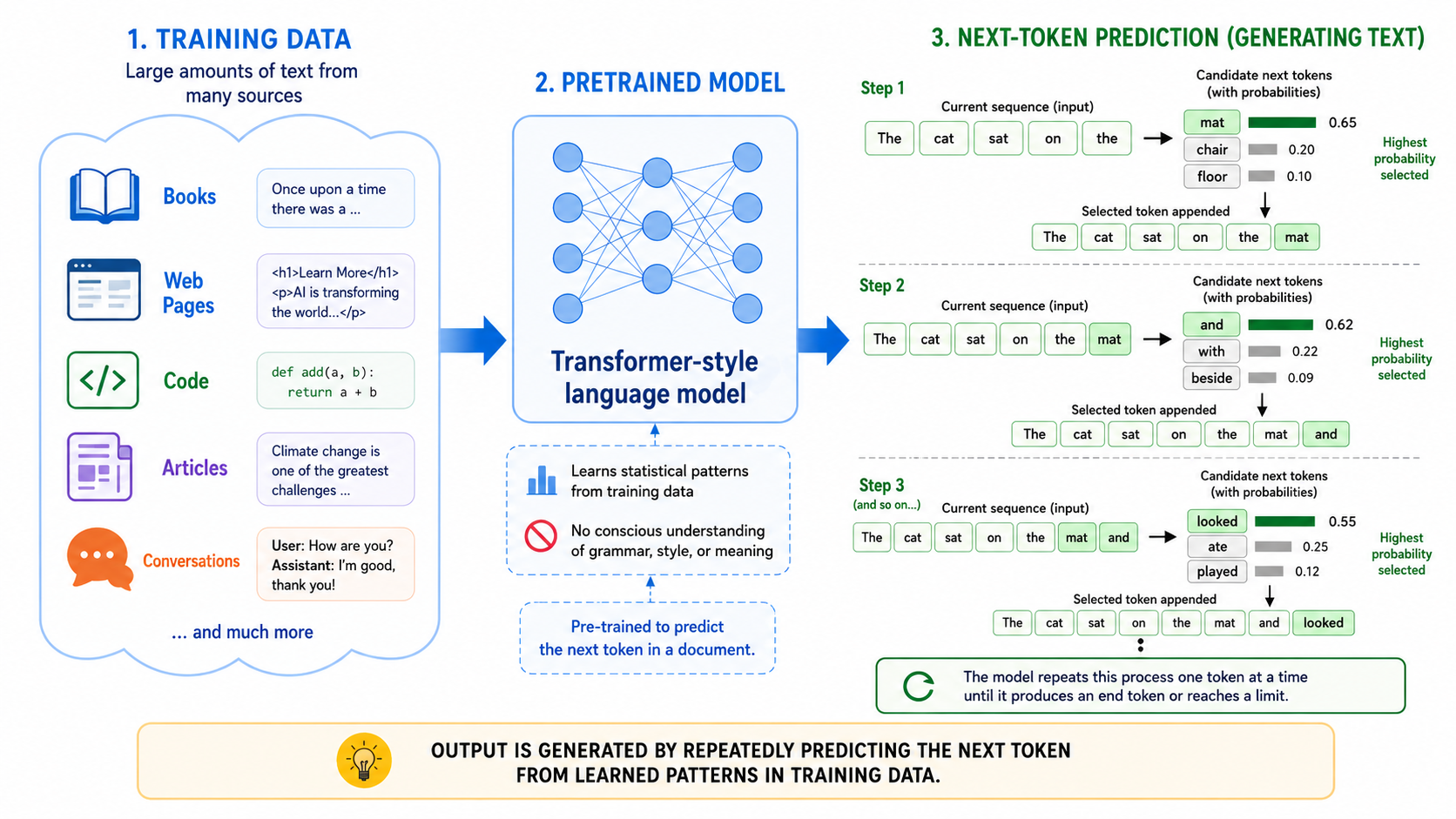
An LLM does not write a complete paragraph in its mind and then type it out. It processes the text as tokens, which can be words, parts of words, punctuation marks, or other small units. It predicts a likely next token from the context, adds that token, and repeats the process, as a sequence of predictions.
The model does not have a conscious understanding of grammar, style, or meaning. It simply predicts what is likely to come next based on the patterns it has learned from its training data. The GPT-4 technical report, for example, describes the base model as a Transformer-style model pre-trained to predict the next token in a document [3].
So why em-dashes are common in LLM responses? Mainly for four reasons:
- Training-data style: LLMs learn from large amounts of edited prose, journalism, essays, documentation, and web writing, where em dashes are fairly common.
- They are structurally convenient: An em dash lets the model add a clarification, contrast, qualification, or side note without fully restructuring the sentence.
- They create a polished tone: Models are often optimized toward fluent, professional-sounding prose. Em dashes can make writing feel more editorial or essay-like.
- Generation habits get reinforced: During instruction tuning and preference optimization, certain stylistic patterns can become disproportionately common. The em dash is one of those patterns.
There is no small rule inside every model that says, “Insert an em-dash after twelve words.” The model has learned from examples that the mark is useful in polished explanatory prose.
One of the strongest reason I predict is that LLMs generate text incrementally and cannot go back and redesign the sentence in the same way a human writer might. If it has already written:
This approach is generally safe
and then decides it needs an important qualification, it can continue naturally:
This approach is generally safe — provided the operation is idempotent.
That is grammatically easy and requires very little restructuring. An em-dash can connect two related thoughts without the hard stop of a full stop. It can introduce a clarification without opening a new sentence, or without modifying the first part of the sentence.
This makes it especially convenient for the kind of writing people commonly request from AI: professional but friendly, clear but not too formal, and concise but still explanatory. The punctuation solves several writing problems with one character.
A Symbol Cannot Confess Its Author
When we call the em-dash an “AI tell,” we mix up two different ideas. A pattern can be more common across a large collection of AI-assisted text, while being useless as proof for one particular paragraph. It may contribute to a broad statistical pattern, but a single use tells us almost nothing about who, or what, wrote it.
This matters because writing habits are personal. Some people prefer short sentences, some like semicolons, some use brackets for every side thought. If we label all polished punctuation as artificial, human writers will start making their writing deliberately worse just to prove they are human. AI has already changed how content is produced; it should not also take ownership of the tools humans invented long before it existed.
The em-dash did not choose to become a symbol of artificial writing. It existed in printing terminology in the nineteenth century and entered Unicode long before AI. What changed was not the symbol, but the scale at which one polished style could suddenly be produced and repeated. A single character was never built to carry that kind of accusation, and it still can’t.
So the next time an em-dash makes you suspicious, question the claim, the sources, and the substance behind it — not the punctuation. That is where authorship actually reveals itself.
What do you think about it? Yes, this post does not have a comment section to share your thoughts. But you are invited to share your thoughts in my LinkedIn post here.